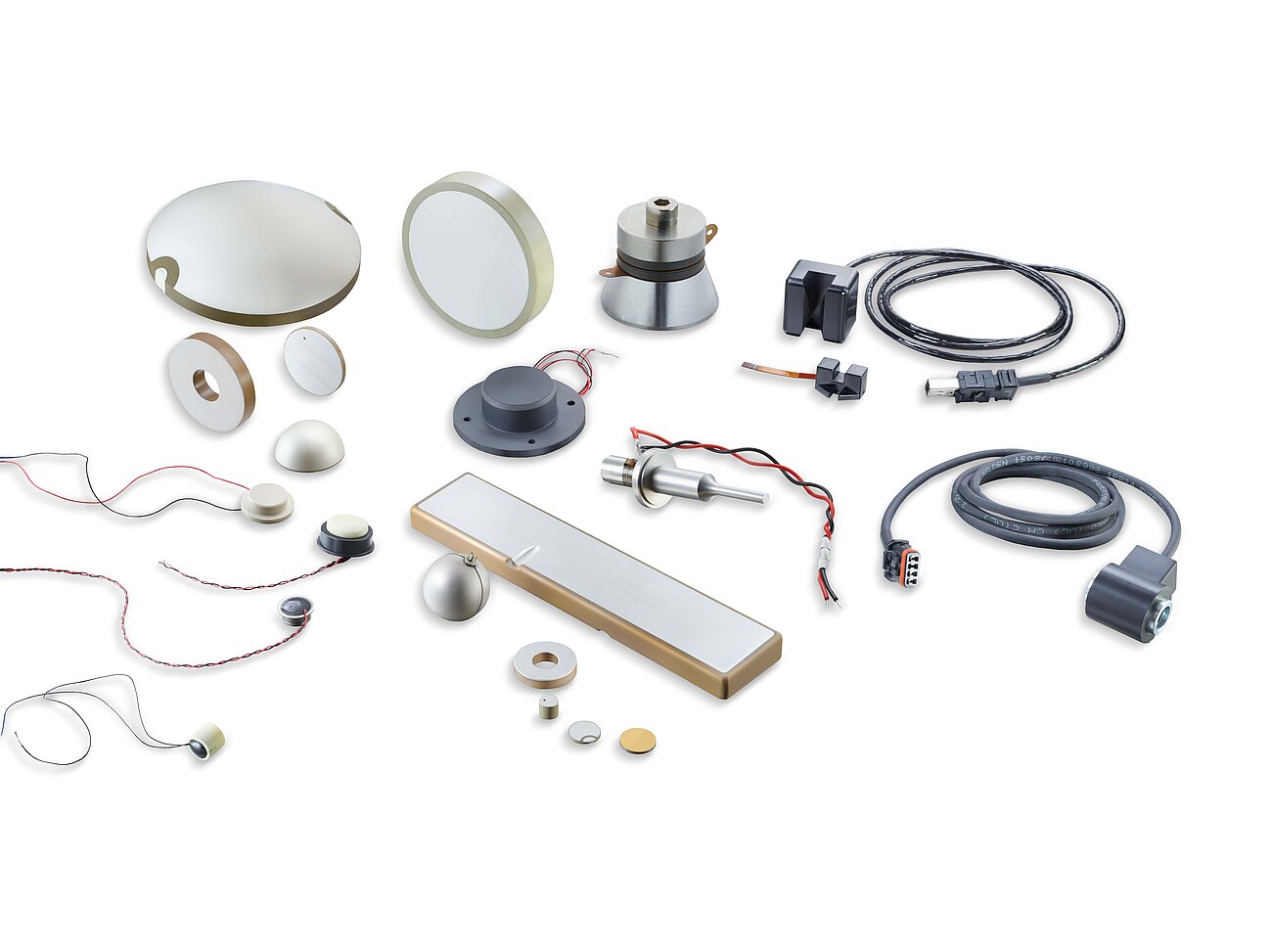
Proven Expertise in Piezoceramic Manufacturing
CeramTec has refined its piezoceramic manufacturing processes and technologies over decades of experience.
Production systems managed in compliance with IATF 16949 requirements provide the foundation for consistently high quality, even for demanding applications in automotive and safety technology. With more than 90% of its product portfolio consisting of customer-specific components, CeramTec combines manufacturing flexibility with high precision, from prototypes and small series to high-volume production.
Despite the wide variety of material compositions tailored to specific application requirements, the manufacture of piezoceramic components follows a common basic process:
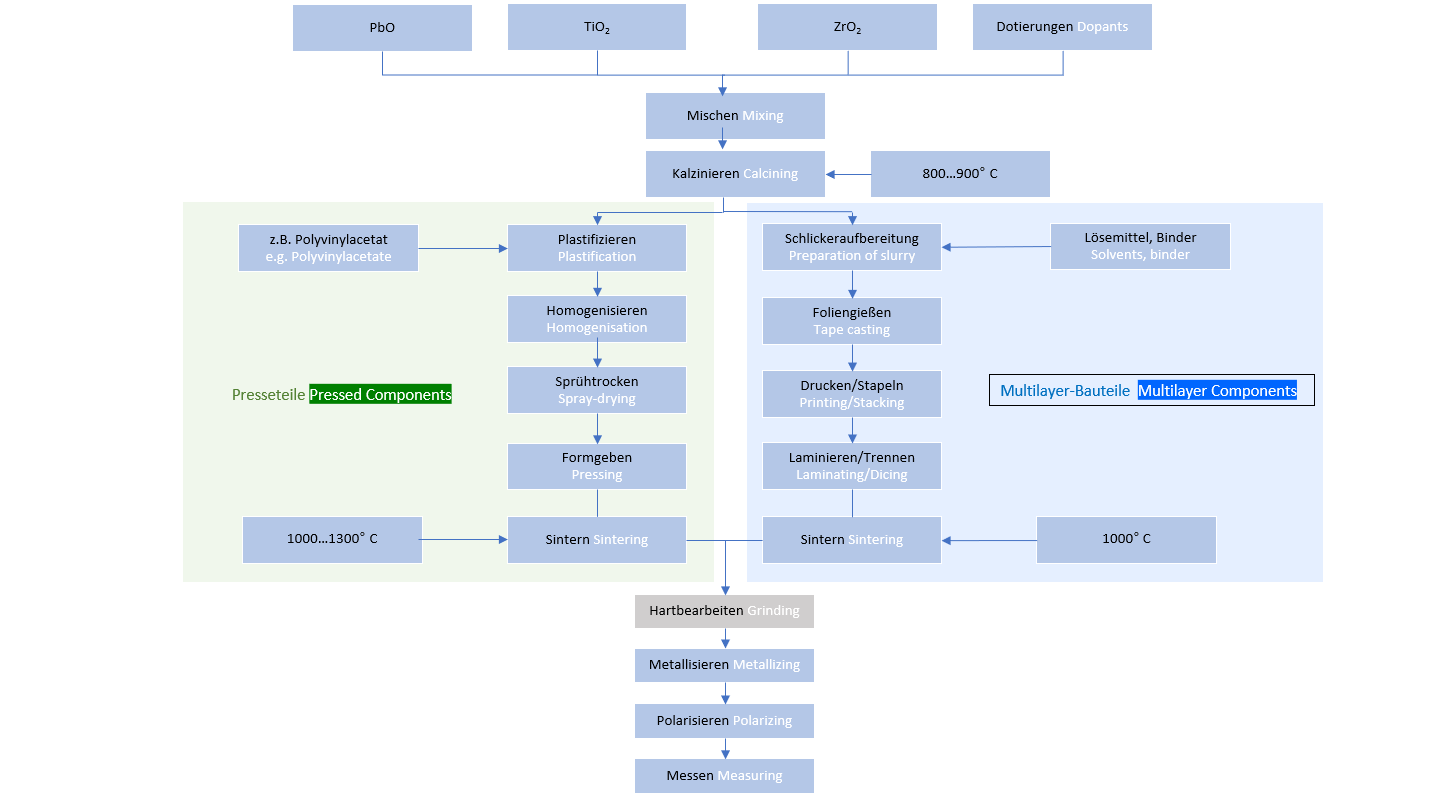
Production typically begins with a powder preparation process in which oxide raw materials are mixed to achieve the defined chemical composition. This is followed by powder conditioning, compaction, and forming processes such as dry pressing. The ceramic blank is then sintered at temperatures between 1,000°C and 1,300°C in a continuous tunnel-type electric furnace. During this sintering process, the material develops its polycrystalline ceramic structure.
The sintered piezoceramic component is mechanically finished using processes such as grinding, lapping, polishing, and sawing to ensure that its dimensions and surface finish remain within specified narrow tolerances. The geometry of the component and its material coefficients determine key functional characteristics, such as capacitance and resonant frequency.
Electrical connections are typically created by applying silver electrodes using a screen-printing process, followed by sintering at approximately 600°C. The component is then polarized by applying a DC electric field of 2 to 3 kV/mm at temperatures between 80°C and 140°C. This process creates the required orientation of the electric dipoles within the ceramic and enables its piezoelectric properties.
During final outgoing inspection, the component is tested against a wide range of parameters, including geometrical dimensions and the adhesion strength of the silver metallization layer. Its piezoelectric properties are also measured and recorded prior to shipment. The parameters to be inspected and the applicable test conditions are defined individually in consultation with the customer.
In-process inspections and a IATF 16949-compliant manufacturing process ensure a consistently high level of quality, even in high-volume production.