Understanding Piezoceramics: Principles, Perovskite Structure and Polarization
Piezoelectricity is based on the ability of certain crystals to generate an electrical charge when subjected to mechanical stress, such as pressure or tension (direct piezoelectric effect). Conversely, these crystals undergo a controlled deformation when exposed to an electric field, a phenomenon known as the inverse piezoelectric effect. The polarity of the charge depends on the orientation of the crystal relative to the direction of the applied mechanical stress.

The Perovskite Structure
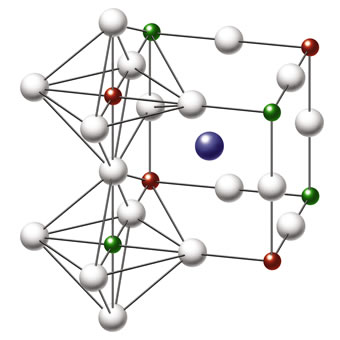
Piezoceramics belong to the group of ferroelectric materials. Many piezoceramic systems are based on lead zirconate titanate (PZT), a solid solution of lead zirconate (PbZrO₃) and lead titanate (PbTiO₃). Piezoceramic components have a polycrystalline structure consisting of numerous crystallites divided into domains. Their unit cells exhibit a characteristic perovskite structure, generally described by the formula ABO₃.
In the representation shown, the divalent A-site cation is located at the center of the cube, while the tetravalent B-site cations occupy the cube corners and the O²⁻ anions are positioned at the centers of the cube edges. For PZT, the A-site is occupied by Pb²⁺ and the B-site by Ti⁴⁺ and Zr⁴⁺.
Below the Curie temperature, distortions of this ideal structure give rise to spontaneous polarization, a key characteristic of ferroelectric materials.
Creating Piezoelectric Properties through Polarization

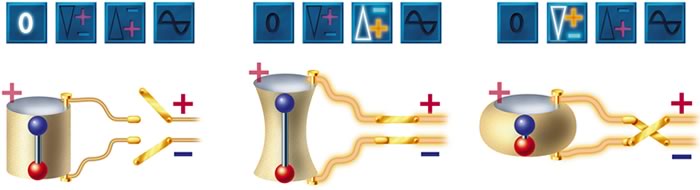
Image: Before, during and after polarisation
Immediately after sintering, the domains of a ceramic body, i.e., regions consisting of unit cells with a uniform dipole orientation, are randomly oriented. As a result, the ceramic body is macroscopically isotropic and does not exhibit piezoelectric properties.
These piezoelectric properties are induced through a process known as poling. During this process, the ceramic body is exposed to a strong DC electric field, causing the electric dipoles to align with the applied field. The dipoles largely maintain this orientation even after the electric field is removed, resulting in remanent polarization, a necessary condition for the piezoelectric behavior of ferroelectric ceramics.